Standard Chartered says faster stablecoin turnover could curb demand
Stablecoin turnover has doubled in the past two years as AI payments and traditional finance use cases grow, though Standard Chartered still sees the market reaching $2 trillion.
Standard Chartered analysts say rising stablecoin velocity could reduce the need for new token supply even as transaction volumes climb.
Stablecoin velocity has doubled over the past two years amid new payment use cases and rising traditional finance (TradFi) activity, Standard Chartered said in a Tuesday report seen by Cointelegraph.
Velocity refers to how often stablecoins are used relative to the amount outstanding, meaning faster turnover can support more transaction volume without requiring the supply to grow at the same pace.
“If velocity remains constant, rising transactions will create demand for more stablecoins, but if it increases, that will not be the case,” Standard Chartered’s head of crypto research, Geoff Kendrick, said.
Despite the potential demand implications, the bank maintains its forecast that the stablecoin market will reach $2 trillion by late 2028, Kendrick said.
Trend challenges earlier assumptions on stablecoin usage
The finding marks a change from Standard Chartered’s earlier assumption that stablecoin velocity would stay broadly stable as the market expanded.
“If velocity increases, however, that would be assumed to reduce the need for the total number of stablecoins required,” Kendrick said.
Related: Ripple CEO says stablecoins could be crypto’s ‘ChatGPT moment’ for businesses
The analyst said the spike in velocity “so far appears” to reflect a gradual shift in stablecoin use toward new use cases, specifically higher-velocity TradFi replacement and AI-related transactions.
Kendrick said there has been no increase in velocity in pre-existing use cases such as emerging market savings.
USDC leads velocity spike, while USDT remains tied to savings use
The sharp surge in stablecoin velocity, reaching turnover of at least six times a month on average, has been driven mainly by Circle’s USDC (USDC), the second-largest stablecoin by market capitalization after Tether’s USDt (USDT).
USDC’s velocity began rising in mid-2024 across all chains, particularly on Solana and Base, highlighting a shift toward TradFi use as well as early AI agentic payments on networks such as Coinbase-backed x402.
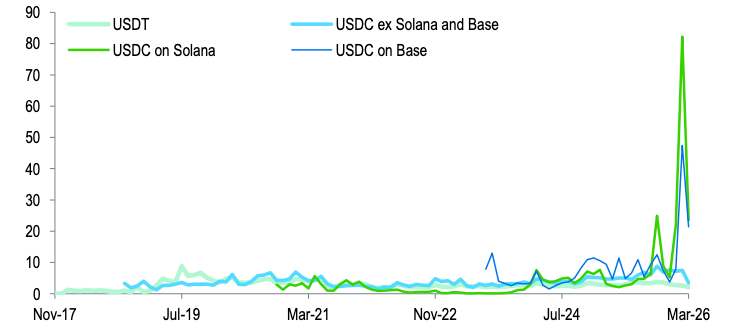
In contrast, USDT velocity remained relatively low, reflecting its stronger position in the lower-velocity emerging market savings use case, Kendrick said.
“In other words, the two market leaders appear to have different strengths by use case — EM savings for USDT and TradFi replacement for USDC,” he added.
Magazine: Nobody knows if quantum secure cryptography will even work