
Russia moves to narrow crypto trading to regulated intermediaries
Russia approved a draft crypto bill package that would push trading through licensed intermediaries and cap retail purchases at $3,700 annually.
Russia’s government has approved a package of draft bills that would channel domestic crypto trading through licensed intermediaries and sharply limit retail access.
The Finance Ministry said Monday that the government had approved a package of draft bills on the legalization of the circulation of digital currencies and digital rights in Russia.
“Under the new regulatory framework, transactions involving digital currency without regulated intermediaries are prohibited,” the ministry said. The package would tighten state oversight of digital assets while preserving limited access for non-qualified investors and broader access for qualified investors.
The framework introduces significant limits for retail investors, allowing purchases of the “most liquid digital currencies” to be defined by the Bank of Russia. Under the rules, retail investors must pass a test and are limited to purchases of up to 300,000 rubles ($3,700) per year through a single intermediary.
The proposal would still allow residents to buy crypto abroad using foreign accounts, provided those transactions are reported to tax authorities, signaling that Moscow is trying to domesticate crypto trading rather than ban it outright.
Crypto operators face licensing requirements
The approved package includes bills on digital currencies and digital rights, amendments to certain Russian legislative acts, as well as changes to the country’s administrative offenses code.
The framework establishes a licensing regime for entities involved in crypto operations, including digital exchanges and custodial services, while allowing banks and brokers to participate under specific regulatory requirements.
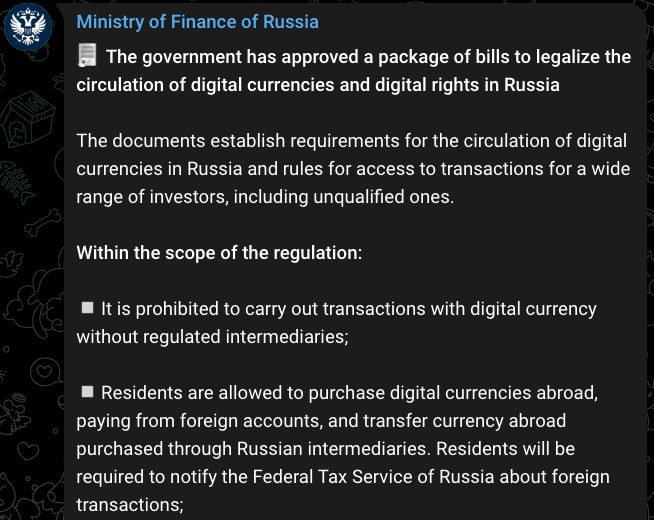
“As for banks and brokers, they will be able to carry out such activities provided they comply with specific prudential requirements,” the announcement notes.
Related: Telegram CEO faces Russia probe over allegations of terrorism facilitation
The package also provides for administrative liability for violations by organizations engaged in exchange activity, part of a broader push to police unlicensed crypto intermediation.
Critics say rules could backfire on oversight goals
While the government aims to formalize the sector, critics say the rules could have the opposite effect, pushing activity into unregulated channels.
“At a time when the rest of the world is moving toward liberalizing access to equity markets through tokenization, we are, for some reason, doing the opposite by pushing crypto into a framework of securities market regulation,” Exved founder Sergey Mendeleev told Cointelegraph.
“In the end, it will be like with casinos — people won’t play less, but everything will move out of state control into online and underground venues,” he said.
Related: ECB paper questions if DeFi DAOs are decentralized enough to sit outside MiCA
Nikita Zubarev, chief analyst at BestChange, emphasized that the legislation does not aim to ban crypto ownership, but rather to “dismantle the accessible, transparent infrastructure for converting crypto to fiat,” thereby isolating the domestic financial system from the global market.
He added that the status of major global exchanges such as Binance and Bybit remains uncertain, while decentralized finance faces heightened legal and operational risks.
“According to the draft law, activities such as issuing crypto loans without a licensed intermediary will be prohibited,” Zubarev said, adding that interacting with decentralized exchanges would carry significant risks due to their lack of a centralized entity:
“That effectively pushes active traders into a legal ‘grey zone’ or forces them to operate under foreign jurisdictions, making it impossible to legally declare income derived from such trading activities.”
Magazine: How crypto laws changed in 2025 — and how they’ll change in 2026